There was one morning, about a year and a half ago now, I think, when one of the most influential teachers in my life, Prof. Curtin, told us a story during class of a trip he made to India. He and his colleagues went through a traveling nightmare, apparently to see and meet the unconditionally benevolent Mother Theresa at the abandoned facilities she was using as a hospital for the helpless. He said he recalled arriving and being immediately put to work, caring for and becoming intimate with those who had not a coin to spend for medical services. The Honorable Mother was restless, tending to each and every broken, diseased and occupationally inviable patient there, unable to tolerate a moment wasted entertaining guests while others lay in their agony. After a few hours of directly experiencing the very real faces of poverty of these slums, the already exhausted travelers began their return to their hotel, leaving unshaken in her compassion-driven stamina the heroic Rev. Mother.
The hotel they returned to was high-class and extensively prosperous, servicing as well some of the wealthiest businessmen in the country. Together, Prof. Curtin's colleagues and these businessmen sat wrapped in towls, surrounded by the steamy waters of the hotel hot tub that overlooked the city, sharing cocktail glasses over bouts of laughter and jokes. Upon coming across this scene, my professor said he felt in himself an absolute shock at the surrealness of the reality he was seeing; how could these men possibly sit in hot tubs, spending money on Epicurean-fashion refreshments, in a tourist hotel that was in part responsible for the wealth imbalance in this region of the nation, with the very men who openly invested in and profited from the businesses to blame for the massive unemployment rate and social welfare injustices felt by those suffering around them? Had they already completely forgotten where they had been that day, the pain on the faces of those unheard by their own government?
Upon hearing the end of this story, I too mysteriously experienced a pain that struck me to the core. I contained my overwhelmed emotions of anguish and bitter resentment -- and just pure sadness -- provoked by the scene my teacher described until class ended and I could return to my dormitory room to dwell on it.
Today, in the far outreaches of a dryland (well known, however, as the Loess Plateau) two hours outside Xi'an, there is a small rural village outlayed on a mountain ridge overlooking a valley. The sun was blazing over the overlapping ridges, eventually reaching its full flammation as the bus climbed one of the steeper and tallest ridges to the top toward the village. We stopped at a small elementary school, sitting directly on the crest of the mountain, its grounds smaller than the standard American suburban home property. In the center of the grounds were four lines of students, suited in traditional garments, waiting patiently for our arrival while their unfashionably dressed parents stood and watched from the periphery. The student stood on either side of a central flagpole, bearing the school's and China's national flags, in the order of their four grades from left to right. Around them was a common U-formation of three miniscule, one-storey buildings that included bathrooms and all other necessary facilities. The students smiles and excitement in seeing the bus stop in front of their school radiated several times more brilliantly than even the summer sun. For the next couple of hours, each grade demonstrated their well-rehearsed lyrical dances and watched us improvise a few American songs and simple dance we recalled from childhood. They exchanged with us pictures and paper ornaments they had made for candy, snacks and sports equipment the program provided us to give them. Going from an order of performance and observation to a chaos of gift-giving, handshakes and attempted greetings between every student and program member, everyone gathered around the back of the primary building to play with the new soccerballs, jump ropes and tennis rackets together. Even the parents standing at the edges of the arena watched with endearment the interactions between their children and travellers from a distant region of the world. Village neighbors stopped their bikes and the occasional truck to stand and watch us from the dirt street out front.
I took this opportunity while many of the others were playing to ask one of the English-speaking coordinators for this visit about the structure and education of the school. I was already aware that it owed its existence to Plan International, an NGO that worked with the government to found such a facility as this within the village, a solution to the common problem in rural regions of China where distance to the nearest schools prevents families from sending their children there, despite the pressures of China's nine-year compulsory education. This particular school had been founded in March last year, which explained the still missing upper grades that would have to wait two years for fulfillment. Five teachers and one principal secured management and teaching positions for 66 students, their salaries payed by the government to meet sufficient living standards though only by unwavering commitment to a contract for occupation. The services of the NGO start with the costs of land purchase, building construction and other financial procedures, but Plan Int. also committed itself to orgainizing an education that would ensure children's participation in matters of decision-making concerning their own education and the development of their rural community. Documented evaluations of their participation presented to the right government authorities would guarantee, the organization believed, a more dedicated and heavier interest in the work such NGOs provided, perhaps to the point of granting them further capacities and resources toward extending their abilities and impact on a national level even. This hope has persevered and may yet for some time to come.
I had to note that among its six subjects of curriculum taught, this school, unlike schools residing in the city that are properly funded, had no science course, by which it might to some extent understand the intricate workings of biology underlying the process of the farming that provided most of the average village family's source of income. This village, a township named Cheng (I believe), occupied a land that was mostly unarable and thus, along with government decree, coerced the villagers to surrender their efforts to nothing but the farming of apple trees, the fruit of which has since become widespread in sale despite the low pay to the farmers who produce them. Acres of procured and harvested apple trees surrounded the school and bordered the residential dwellings of the villagers. The direness of this singular dependency on an only mildly dependable crop -- that is, the bad side of extreme monoculture -- seemed to me exacerbated by the singular dependency of the future farmer's cultivation and maintanance on only their own family's breadwinner, who probably now knows little other than how to grow and tend apple trees. I wondered what immediate effects could be seen in the hypothetical introduction of science classes that incorporated an education of farming biochemistry, preferably twoard the long-term goal of sustainable development over industrial economic development (at this point now belabord ad nausium by government authorities). (Perhaps I can receive some responding comments here from my knowledgeable and dear friend, Tom, on this subject...)
The residences still comprised of mudcake blocks for houses, now in their better days also having adjoining brick additions deliberately constructed in front to hide the older facilities. Government slogans promoting the one-child policy -- which is almost entirely ineffective our here where extra farmhands are necessary for survival -- and some of the more profitable names of local businesses stained the walls of nearly every home in striking red and white hues, all beyond the choice or even likely the care of the homes' owners. We visited two near the school, both with children attending the school: The Wang family occupied a hand-shoveled out five-room mostly underground dwelling, meant for their family of six, which they built within three months of the year 1973. The dirt and concrete walls were covered in newspaper clippings and magazine ads, which they said was meant for decoration. Their kitchen stove was a metal table over a small fire pit. They all shared beds. Meanwhile, standing a little closer toward the center of the village was the Liuo family, whose slightly higher-status abode housed only five people and, being built in the 1990s, was all above ground in the more contemporary fashion. The presence of more furniture in their homes did not hide the fact that it was all of the poorest quality by our standards. Both families had children and spoke in a tongue that even our Chinese guide could not interpret. In showing us their homes, I noticed both families carrying a plain and simple pride, marked with curiosity at our desire to see their abodes and well-accustomed living standards. Regardless to the shock in difference between this and what we had all see in China so far, the official I inquiried at the school told me that he himself hardly considered this region 'poor' -- after all, it unlike many had the tremendous benefity of having roads (whatever their condition) to travel and by which we were able to come to see it.
I got on the bus for the return to the city in a state of extreme yearning to get back off and stay and work alongside these people -- these people who still knew what work was in terms of day by day survival. No amount of briefing or description truly prepares us for the absolute reality that presents itself when we come to these places -- be it the outlying regions of centralized China, or the often ignored backwater neighborhoods of Mississippi or Louisiana. And the moment we feel the impulsive urge to do something, not merely pass judgement or console ourselves through agreements of pity with our same-status peers, is the same moment we are forced to regard the full realy of OUR living conditions, our worldview and complementary lifestyle, now under the threat of not being the innocent society or example of justice we thought it was. The world's globalization necessarily must include an integration of even the most regional perspectives to account for the lack of responsibility toward them that has ensued on the part of every one of us thus far. It entails a shaking of one's present world to dislodge from it the pieces yet unseen, unseen but just as intimately vital to the continuous activity of compassion and responsible living.
That evening, I ate with the others at a fanciful restaurant to the point of bloating; I joined some on a trip to a professional foot massage; I sat with them in the polished brass and marble hotel lound drinking tea and champagne; and I continued to despair in the surrealiness, the absolute shock that applied as readly to myself as to those around me: Had I alreadly forgotten where I had been today? For a moment, I thought I could feel the inclination of Prof. Curtin's comfort-seeking fellow travelers, the desire, however indeliberate it may be, to disregard the inadequacies of what I have known, and have now come to know, to be true, to retreat into the simpler logic of pleasures and pains of only oneself, to respond to the inconsistent pieces of the story unfolding before us with the security that "at least I am satisfied, at least I have the potential within my lifetime to be happy." This statement, in a sense, is not possible for me anymore, so long as I know and adhere to the truths that promote remembering what is forgotten. As was said by the famous utilitarian years before, "'Tis better to be Socrates unsatisfied than a pig satisfied." I would restate it now it its potentially evolved form: "It is better to realize satisfaction through not merely attempting to avoid depriving it from others, but creating happiness in the lives of all concerned, which in part entails learning about them -- and oneself through them." Make a nice day.
Friday, June 01, 2007


Thursday, May 31, 2007
Day Five
This morning held an opportunity I could have only imagined before: a private conference with the diplomats of China's Ministry of Foreign Affairs. The panel that sat at the Front of the press room were Deputy Director Shi Yuanqiang -- who gave no speech but led us through question and answering afterward -- Deputy Director General Xie Feng -- who did most of the talking throughout -- Assistant Minister He Yafei -- who left for another meeting immediately after his opening remarks -- and Councilor Feng Tie -- whose speciality appeared to be SARs (Special Autonomous Regions) like Hong Kong, Macao and Taiwan, but who received no questions from us at all after his speech.
Questions were naturally given preformulated answers or, for unexpected questions, vague interpretations of already mostly obvious answers. Considering my intimate connections with Japan at this point, I took it upon myself to ask at least one question regarding Chinese-Japanese relations. In answer to my request for a description of China's response to Japan's Prime Minister Shinzo Abe's call for militarization -- which was supposedly cued by North Korea's explicit nuclear armament -- Deputy Director Xie replied that relations have been mostly peaceful with Japan since the war but that China hopes it has learned its lessons from that time. This is a good example of a vague interpretation of an alreadly obvious fact or likely opinion. However, this is expectable of diplomats, expecially those representing any form of government endorsing the simple message of peaceful international harmony and national development. The extent to which international harmony was stressed, though, was beyond what I had expected.
We then split into several smaller groups, to allow us to have a larger number of our questions answered, as well as to allow the interning representatives for these representatives to practice addressing our questions. In my group, I put a little pressure on the intern to list any concerns the CCP (China's Communist Party -- which has held the primary legislative and executive positions in China's government for decades now) or other government officials might be showing for the degradation (perhaps soon to be near obliteration) of the cultural identity for the Chinese minorities (less often regarded ethnicities) living in the SARs. With the CCP in place as it is, local democratic governments of any region are consistently bureaucratically managed by installed authorities of the CCP, all aiming (in a very monistic fashion) toward the goal of a nationally unified economic development and higher ranking GDP: a more highly recognized economic status at the price of (among other things) minoritarian cultureal erasure. He remarked that respect for these culture was still a point of attention for the government -- as can be seen in its granted funds to refurbish the Buddhist monasteries and temples in Tibet -- and that the CCP, since its formation in 1921, has always served as the country's most active agent in the democratic movement. (By the way, do not forget that I am NOT referring here to a form of democracy that necessarily resembles our American form of government.) Of course, the matter of the prolonged banishment of the Dalai Lama and his brotherhood services remains a problem left unaddressed...
Several hours later, we were on a plane bound for Xi'an, far away from the observable centralization and racing industrialization taht Beijing displayed. It was time to see another face of China.
Questions were naturally given preformulated answers or, for unexpected questions, vague interpretations of already mostly obvious answers. Considering my intimate connections with Japan at this point, I took it upon myself to ask at least one question regarding Chinese-Japanese relations. In answer to my request for a description of China's response to Japan's Prime Minister Shinzo Abe's call for militarization -- which was supposedly cued by North Korea's explicit nuclear armament -- Deputy Director Xie replied that relations have been mostly peaceful with Japan since the war but that China hopes it has learned its lessons from that time. This is a good example of a vague interpretation of an alreadly obvious fact or likely opinion. However, this is expectable of diplomats, expecially those representing any form of government endorsing the simple message of peaceful international harmony and national development. The extent to which international harmony was stressed, though, was beyond what I had expected.
We then split into several smaller groups, to allow us to have a larger number of our questions answered, as well as to allow the interning representatives for these representatives to practice addressing our questions. In my group, I put a little pressure on the intern to list any concerns the CCP (China's Communist Party -- which has held the primary legislative and executive positions in China's government for decades now) or other government officials might be showing for the degradation (perhaps soon to be near obliteration) of the cultural identity for the Chinese minorities (less often regarded ethnicities) living in the SARs. With the CCP in place as it is, local democratic governments of any region are consistently bureaucratically managed by installed authorities of the CCP, all aiming (in a very monistic fashion) toward the goal of a nationally unified economic development and higher ranking GDP: a more highly recognized economic status at the price of (among other things) minoritarian cultureal erasure. He remarked that respect for these culture was still a point of attention for the government -- as can be seen in its granted funds to refurbish the Buddhist monasteries and temples in Tibet -- and that the CCP, since its formation in 1921, has always served as the country's most active agent in the democratic movement. (By the way, do not forget that I am NOT referring here to a form of democracy that necessarily resembles our American form of government.) Of course, the matter of the prolonged banishment of the Dalai Lama and his brotherhood services remains a problem left unaddressed...
Several hours later, we were on a plane bound for Xi'an, far away from the observable centralization and racing industrialization taht Beijing displayed. It was time to see another face of China.
Wednesday, May 30, 2007
Day Four
This morning, we made an early trek out to the Temple of Heaven. The parks around it, filled with hordes of people practicing tai chi, fan dances, and just general wandering, stretched in all directions, it seemed. The music and song of old China rose in pockets between the lines of trees, to remind us occasionally of the sheer age and depth of culture into which we were entering.
Within the actual temple grounds, we came upon the central Hall of Prayer for Good Harvest, a three-tiered monolight that punctured the gray sky above with its tip. The first tier depicted carvings of clounds; the second, the heads and torsos of an army of phoenixes; ending at the top with an army of dragons. These designated the realms of Earth, the emperor's domain, and Heaven, respectively. The temple grounds felt immense for such a small place, and in the distance, one could see the outskirts of the city, modest in its proximity as if scared to approach the depth of geographical sacredness the place held.
Following that, we dined at an ethically diverse cafeteria-type restaurant, the Yu Friendship Store. I tasted practically everything laid upon the inset turntable (to which I was quickly becoming accustomed), unable to contain my excitement to eat. (I suppose it is still one of my top absolute favorite things to do.) The bottom floor featured an arts exhibition, with glass shelves and counters arrayed with all manner and color of fabric by creation. I had earlier that morning bought a traditional-design robin's eggo blue sild pillow case for a friend, and decided that I wanted to purchase a small, darkly blue-and-purpled bird that sat among a flock of much taller roosters and pheasants, all of them inlaid with intricate patters of copper lining between which paints were set, fired, and glossed. Walking around, I became obsessed with the mastery of the makers of all these pieces, as they openly created them right there in the room for others to observe. I was particularly enraptured by the process of one man who painted -- in the centuries-old sumi-e style (I do not yet know the Chinese word for it) -- upon the inside of hollowed glass globes, pictures of everything from zodiac animals to market places to battlefields.
Our final group destination was the Great Wall. I captured everything I could on my cellphone camera, having sadly used up my digital memory from the previous couple of days and no time to upload it to the internet or somewhere. (Memory cards were intolerably expensive where I was, and I had had no practical foresight to buys any before coming.) I did my very best not to go overboard, allowing my senses to take in the most there was to experience in the place -- the age, the immensity, the singularity of its design and purpose, the sheer coercion of its construction without regard to slope or topographical obstacles. We stood together in the light fog surrounding the mountains, watching people of arbitrary ethnicities climb over and through the wall's convoluted structure, like ants investigating an ancient and warped spinal column in the cool mist. The very dynamics of its intended polarization -- inside and outside -- now deintensified by the lack of the geopolitical border it once maintained, made it seem lonely but forever tenacious in its purpose. It was one of those few things that highlights the sacred truth that the dead always live on.
The day ended with the best Indian curry (a vegetable kofta, to be precise) that I have ever tasted. Just when you think you have already had the very best of something...
Within the actual temple grounds, we came upon the central Hall of Prayer for Good Harvest, a three-tiered monolight that punctured the gray sky above with its tip. The first tier depicted carvings of clounds; the second, the heads and torsos of an army of phoenixes; ending at the top with an army of dragons. These designated the realms of Earth, the emperor's domain, and Heaven, respectively. The temple grounds felt immense for such a small place, and in the distance, one could see the outskirts of the city, modest in its proximity as if scared to approach the depth of geographical sacredness the place held.
Following that, we dined at an ethically diverse cafeteria-type restaurant, the Yu Friendship Store. I tasted practically everything laid upon the inset turntable (to which I was quickly becoming accustomed), unable to contain my excitement to eat. (I suppose it is still one of my top absolute favorite things to do.) The bottom floor featured an arts exhibition, with glass shelves and counters arrayed with all manner and color of fabric by creation. I had earlier that morning bought a traditional-design robin's eggo blue sild pillow case for a friend, and decided that I wanted to purchase a small, darkly blue-and-purpled bird that sat among a flock of much taller roosters and pheasants, all of them inlaid with intricate patters of copper lining between which paints were set, fired, and glossed. Walking around, I became obsessed with the mastery of the makers of all these pieces, as they openly created them right there in the room for others to observe. I was particularly enraptured by the process of one man who painted -- in the centuries-old sumi-e style (I do not yet know the Chinese word for it) -- upon the inside of hollowed glass globes, pictures of everything from zodiac animals to market places to battlefields.
Our final group destination was the Great Wall. I captured everything I could on my cellphone camera, having sadly used up my digital memory from the previous couple of days and no time to upload it to the internet or somewhere. (Memory cards were intolerably expensive where I was, and I had had no practical foresight to buys any before coming.) I did my very best not to go overboard, allowing my senses to take in the most there was to experience in the place -- the age, the immensity, the singularity of its design and purpose, the sheer coercion of its construction without regard to slope or topographical obstacles. We stood together in the light fog surrounding the mountains, watching people of arbitrary ethnicities climb over and through the wall's convoluted structure, like ants investigating an ancient and warped spinal column in the cool mist. The very dynamics of its intended polarization -- inside and outside -- now deintensified by the lack of the geopolitical border it once maintained, made it seem lonely but forever tenacious in its purpose. It was one of those few things that highlights the sacred truth that the dead always live on.
The day ended with the best Indian curry (a vegetable kofta, to be precise) that I have ever tasted. Just when you think you have already had the very best of something...
Tuesday, May 29, 2007
Day Three
6:30 wakeup call; 7:30 bus departure. We left in our formal suits and dresses for our first private lecture at Tsinghua University. The lecturer was Dr. Yuan Peng, whose specialty and lecture topic concerned Sino-American relations and foreign policies. I took extensive notes...
At the end of the lecture, during questions-and-answers, a single Chinese girl -- first in Chinese, than in English -- asked the professor about cooperative government and then turned to us, Americans, to ask by what means we demonstrated our love for our motherland, as she herself wished to do. One or two people hesitatnly made comments about volunteer work or what-not, but I came to realize that not one of us had adequately understood the question. It would seem, at least now to the Chinese students and professor in that room, that the idea of a steadfast love for one's country, to the same extent as for one's mother, has practically to residence in the mainstream concept of politics for young Americans. What is 200 years, anyway, compared to 5000, no matter how long we may be adjusted to our present economy and form of government? It is an idea with little ground for us...
We had lunch on campus, where each table of seven or eight people was joined by a university student. To my excitement, my table was joined by a Ms. Maeda Yoshie (前田よしえ), who was originally from Kobe and had come to Beijing to study law (-- her mother was Chinese and her dad provided the law influence). It was unexplainably lovely to exchange some words in her native tongue, making me realize, after our brief conversation about my job and her family, how very intimately Japanese has become a part of me, a part that felt as though it had been holding its breath before surfacing, now forced again for the time being to remain submerged. She proffered her card (名刺), and I planned to contact her again as soon as I could.
The next stop was the U.S. Embassy, into which I was prohibited to carry even a pen and paper notebook to record the one-hour interview with four of the embassies staff members; I have thus forgotten their names. They took their seats at the front of the small, florescent-lit delegation room -- three more or less obviously American middle-aged men, who specialized respectively in diplomatic relations, education/environmental/cultural policy reform, and economic reform: and between them sat a woman of Asian descent whose primary office, I believe, was human resources. They each gave a brief outline of their role and position in the embassy and then immediately opened the floor to questions. We, the students, as expected jabbed them with a few difficult, or at least detailed, inquiries, to which the staff members responded with a good deal of beating around the bush -- no less than Dr. Yuan had in response to questions that entailed giving his personal opinion or equally detailing answers. Many of us failed to get our questions addressed at all. A great opportunity given too little time to experience it.
We returned to the hotel, changed clothes, and had our debriefing of the past two days. It was rather difficult to believe that we had in fact covered as much ground as we did in just under 48 hours. But many of the deeper implications to what we had seen and heard still seemed lost on some of the (many) less contemplative group members. It still seemed to me taht everyone was continuing to speak of democracy and capitalism as though America represented the only true model of either, and I made an open comment about it toward the end of the meeting. I hoped that even a few were truly comprehending my lead. To be unaware of our language, in whatever realm of subject, especially in a country as foreign as China, can too easily be compared to walking into a dark room with a sword you only think you know how to wield -- everyone is prone to the diplomatic error of forgetting that they are the very embodiment of assumptions about life and what it even means to be living, let alone forgetting what some of those assumptions are. Knowing we would soon leave Beijing in another day, I quietly anticipated finding out how deep some of those assumptions lay for us considering the experiences we would soon have away from the familiarity and comforts of the city.
The evening ended with a trip to the theatre: a narrativeless piece comprised in its entirety of body motion, in dance, kung-fu, and stunts of balance and pain that again challenge the assumptions of what the body can do. The story of the hero, aspiring endlessly to become a perfect master in his art, even as to avoid the temptations of a beautiful woman from his dreams, deeply moved something in me, churning my melted innards to the rhythm and tones of a mix of traditional (and modernly-depicted 'traditional') soundtrack. I fell in love with the lights and colors and hot smells as well as the fluctuations of speed that marked the phases of inner evolution of the boy-monk becoming master of the bodymind, becoming out of the pure necessity of his fated being. The warrior in me -- aware, too, of the warrior in you -- stirs at the thought.
At the end of the lecture, during questions-and-answers, a single Chinese girl -- first in Chinese, than in English -- asked the professor about cooperative government and then turned to us, Americans, to ask by what means we demonstrated our love for our motherland, as she herself wished to do. One or two people hesitatnly made comments about volunteer work or what-not, but I came to realize that not one of us had adequately understood the question. It would seem, at least now to the Chinese students and professor in that room, that the idea of a steadfast love for one's country, to the same extent as for one's mother, has practically to residence in the mainstream concept of politics for young Americans. What is 200 years, anyway, compared to 5000, no matter how long we may be adjusted to our present economy and form of government? It is an idea with little ground for us...
We had lunch on campus, where each table of seven or eight people was joined by a university student. To my excitement, my table was joined by a Ms. Maeda Yoshie (前田よしえ), who was originally from Kobe and had come to Beijing to study law (-- her mother was Chinese and her dad provided the law influence). It was unexplainably lovely to exchange some words in her native tongue, making me realize, after our brief conversation about my job and her family, how very intimately Japanese has become a part of me, a part that felt as though it had been holding its breath before surfacing, now forced again for the time being to remain submerged. She proffered her card (名刺), and I planned to contact her again as soon as I could.
The next stop was the U.S. Embassy, into which I was prohibited to carry even a pen and paper notebook to record the one-hour interview with four of the embassies staff members; I have thus forgotten their names. They took their seats at the front of the small, florescent-lit delegation room -- three more or less obviously American middle-aged men, who specialized respectively in diplomatic relations, education/environmental/cultural policy reform, and economic reform: and between them sat a woman of Asian descent whose primary office, I believe, was human resources. They each gave a brief outline of their role and position in the embassy and then immediately opened the floor to questions. We, the students, as expected jabbed them with a few difficult, or at least detailed, inquiries, to which the staff members responded with a good deal of beating around the bush -- no less than Dr. Yuan had in response to questions that entailed giving his personal opinion or equally detailing answers. Many of us failed to get our questions addressed at all. A great opportunity given too little time to experience it.
We returned to the hotel, changed clothes, and had our debriefing of the past two days. It was rather difficult to believe that we had in fact covered as much ground as we did in just under 48 hours. But many of the deeper implications to what we had seen and heard still seemed lost on some of the (many) less contemplative group members. It still seemed to me taht everyone was continuing to speak of democracy and capitalism as though America represented the only true model of either, and I made an open comment about it toward the end of the meeting. I hoped that even a few were truly comprehending my lead. To be unaware of our language, in whatever realm of subject, especially in a country as foreign as China, can too easily be compared to walking into a dark room with a sword you only think you know how to wield -- everyone is prone to the diplomatic error of forgetting that they are the very embodiment of assumptions about life and what it even means to be living, let alone forgetting what some of those assumptions are. Knowing we would soon leave Beijing in another day, I quietly anticipated finding out how deep some of those assumptions lay for us considering the experiences we would soon have away from the familiarity and comforts of the city.
The evening ended with a trip to the theatre: a narrativeless piece comprised in its entirety of body motion, in dance, kung-fu, and stunts of balance and pain that again challenge the assumptions of what the body can do. The story of the hero, aspiring endlessly to become a perfect master in his art, even as to avoid the temptations of a beautiful woman from his dreams, deeply moved something in me, churning my melted innards to the rhythm and tones of a mix of traditional (and modernly-depicted 'traditional') soundtrack. I fell in love with the lights and colors and hot smells as well as the fluctuations of speed that marked the phases of inner evolution of the boy-monk becoming master of the bodymind, becoming out of the pure necessity of his fated being. The warrior in me -- aware, too, of the warrior in you -- stirs at the thought.
Monday, May 28, 2007
Day Two
I awoke the next morning to find a rather different city than the one I had sleepwalked through the night before. Parts of it did indeed still resemble my home city in America -- probably the same parts that every other city in the world shares with Nashville. But the characteristic differences in Beijing were far easier to perceive in the light.
It started with some features of the hotel itself. The oddly placed Western suburban appearance to the room was slightly jostling but more or less easy to adjust to. An open arena, with the exception of the fenced-in basketball and tennis courts, resembled a small park and children's gymnasium setting -- though what it basically comprised was a strip of strikingly green grass and some trees, erratically spotted with what were actually brightly colored adults' manual athletic devices. All this was encompassed by a straight, looming wall whose full-length printed illustrated depicted the outside of a traditional leisure house surrounded, to the entiretly of the left side, by a blue-green quiet marsh, complete with a crowd off lilypad heads. Fading red, pink and white chrysanthemums stood in waist-high patches along portions of the concrete walk, which eventually came to an open patio marked on one side by a red and rust-brown covering for a row of opposing benches. Just in front of that stood a vertically poised stone of a short man's height, embedded in a white concrete founding. The open patio area was aligned by tiling, set off by dark borders, and let me to guess that it was an area for independent taichi practicers. A nostalgic but small grove of bamboo grew to the right of the benches, right at the base of the photographed leisure house and next to a stylish gazebo that matched the bench covering, including even a ridiculously small and insignificant waterfall.
Beyond the wall, I could see the tracks to one of the nicer trains I thought I would see; just beyond the tracks, another strip of park whose color of green and off-color chrysanthemums resembled the first. Just beyond that, separated only by a lime-green fencing and forcing a stark contrast with the city that grew all around it sat a block of old houses, connected at lenght by their brick and concrete walling, their roofs revealing the true color and traditional form the bench covering and gazebo had been intended to imitate.
act spontaneously within the limits of the moment
touch the kingdom with a gentle hand
embrace peace and cultivate stillness
shape your intention and let it overflow
allow good things to happen without meddling
allow your bodymind to order itself
-- Tao Te Ching, Ch. 57
It started with some features of the hotel itself. The oddly placed Western suburban appearance to the room was slightly jostling but more or less easy to adjust to. An open arena, with the exception of the fenced-in basketball and tennis courts, resembled a small park and children's gymnasium setting -- though what it basically comprised was a strip of strikingly green grass and some trees, erratically spotted with what were actually brightly colored adults' manual athletic devices. All this was encompassed by a straight, looming wall whose full-length printed illustrated depicted the outside of a traditional leisure house surrounded, to the entiretly of the left side, by a blue-green quiet marsh, complete with a crowd off lilypad heads. Fading red, pink and white chrysanthemums stood in waist-high patches along portions of the concrete walk, which eventually came to an open patio marked on one side by a red and rust-brown covering for a row of opposing benches. Just in front of that stood a vertically poised stone of a short man's height, embedded in a white concrete founding. The open patio area was aligned by tiling, set off by dark borders, and let me to guess that it was an area for independent taichi practicers. A nostalgic but small grove of bamboo grew to the right of the benches, right at the base of the photographed leisure house and next to a stylish gazebo that matched the bench covering, including even a ridiculously small and insignificant waterfall.
Beyond the wall, I could see the tracks to one of the nicer trains I thought I would see; just beyond the tracks, another strip of park whose color of green and off-color chrysanthemums resembled the first. Just beyond that, separated only by a lime-green fencing and forcing a stark contrast with the city that grew all around it sat a block of old houses, connected at lenght by their brick and concrete walling, their roofs revealing the true color and traditional form the bench covering and gazebo had been intended to imitate.
>>><<<
do things without appearing to do thingsact spontaneously within the limits of the moment
touch the kingdom with a gentle hand
embrace peace and cultivate stillness
shape your intention and let it overflow
allow good things to happen without meddling
allow your bodymind to order itself
-- Tao Te Ching, Ch. 57
Sunday, May 27, 2007
Day One of ISLP study abroad in China
Seems it's always just trying to get to the airport on time that's the hardest part. I set my alarm for 5 and 5:30 AM, assured that if one did not get me up the other most certainly would, though 5:30 would have been a significantly late start. When I opened my eyes to the morning sunlight, the reflex linked to some unconscious understanding of the time given the amount of light in a room flung me across the bed to wrench my cell phone, which read 5:45, from its charger on the bedstand. I made my fastest morning exit ever at 5:48 and took an extra three minutes to discover that my suitcase was too unwieldy to ride my bicycle with. Knowing no taxi phone numbers and that the first city bus did not make its rounds until 7:30 -- almost an hour after the bus departure for the airport -- I wielded the lumbersome brick of a suitcase over my shoulderblades, clutching the handles on either side, and ran (if you can call it running) like mad in the direction of the station on the bank of the inland sea ferry ports. Another impossible situation where all I could do was raise my face up and say, "Okay, I'm doing my part here..."
The only convenience store within a manageable distance, considering the time, was crowded -- no use calling for help there. Then, raising my head again to break the perceptual rhythm of my awkward panting, I saw a single black taxi cab, in all its shiny chrome glory, sitting quietly at the curb less than a block up the street. I used what energy was left to bound up to it and wheeze my destination to the driver.
I got to the terminal about twenty minutes early.
-- ibid, Ch.58
>>><<<
A long day as expected.
We began with a two-plus hour orientation, reviewing points of culture and history, as well as terms of behavior to apply to the length of our visit. There was also an introduction, a brief synopsis of who each of us were, followed by where we were from and some 'unique point' about ourselves, each given by the individual on our left within a congregation of eight or nine small circles. From across the room, I heard the point made that someone was a vegan and a feminist -- I took note of her and later learned her name, E---. By the end of the day, I would come to know her and a couple of others a little better.
We were on our own for lunch, so I trailed a few other people by taxi to a local mall. Walking with two other guys up floor after floor of fashion and garment design, gaining bit by bit more confidence in my ability to decipher the Chinese characters through my Japanese training, I eventually found myself standing with them within a crowded top-level food court, congested with four-chair tables, fake plants, neon lights, and confusing mixtures of smell. My self-confidence had for whatever reason peaked by that point, and I took us up to a counter for Chinese donbori (whatever that might be in Chinese). It seemed all too easy: just say "I want" and the number of for the set in the menu listed above. I chose tofu -- again, proud that I could read that it was indeed that -- and pulled off my most nonchalant Chinese ordering voice. "I want five." The woman looked at me blankly and gestured toward a copy of the menu that lay on the counter between us. I pointed and said again, "I want five." The woman looked up to me.
"Five?"
"Yes."
She then began to rattle off questions concerning size and side orders, and I managed to complete the rest of my stunt through pointing and grunted confirmations. She seemed inclined to sell me the drink in a special dinky thermos that had a built-in straw, and not having the stamina, nor even the actual ability, to argue with her, I agree to it.
I turned to the guys next to me with what must have been a look of boast on my face when the woman handed me a large clear bag filled with drink thermoses over the counter. I blinked, absolutely lost to what was happening, just as the full nature of my error dawned on me. I quickly tried to get the woman's attention, racing through the practically nonexistant vocabulary list I had with which I might tell her what I meant; a girl my age behind me even asked if she could help, in clear, nearly perfect English, because she was tired of waiting in line to order. But even as she talked between the clerk and me, trying to reach what was supposed to be such a simple agreement of terms, the result of the damage revealed itself at the left of the cashier: a tray of five tofu rice bowl sets ready to be picked up. The error eventually cleared up, but the blood in my face did not go away for several long minutes. I made plans to study Chinese more thoroughly later that night.
The Gate, literally just across the road from the Square, stood as a massive wall, featuring on its front the renowned face of Mao Tsetung in painting, and having bridges lead one into its ominous and dark tunnel entrances. Despite their appearance, the entrances immediately gave way to the light of the first courtyard of the outer palace to the Forbidden City. For the next two or three hours, we caravanned thorugh courtyard after courtyard, intermittently enlighted by stories of the emperors and their successes (or failures) provided by our tour guide.
Having finally reached the inner palace, where no men, save the emperor and his eunichs, had been allowed to enter only a couple of centuries before, we viewed leisure rooms and statues for emperors of every dynasty. Our last stop before exiting was the imperial gardens, where stood in magnificent architectural grandeur stones imported from Thailand that ellicited images of waterfalls with not water, and cedar tees that we were told included many as old as two and a half centuries.
Our evening concluded with Peking duck -- the likes of which I do not think I have ever tasted and cannot begin to describe in its marvelous, succulent flavor -- and more stories about tables about people's backgrounds and intentions for travel. I was exhausted by eight fifteen.
Through more unraveling of the beautiful mystery, I met a guy who also had a keen interest in philosophy, though his special interest was Kierkegaard. I told him a bit what I was looking into, and then, as the talk began to become more focused on the nature of belief in today's philosophy of politics, I gave him Slavov Zizek's name (that's right, Tom -- you became extensive that night too), saying I had never read him but that the couple of lectures I had seen him give were fantastic (...and controversial for me). Andreas seemed pleased, and we parted promising another discussion before our final departure.
This was in the dark bar on the botoom floor of the hotel. Several members of the group had gathered there for some 'buy one, get one free' Beijing draft opportunity. We, the Americans were noisy... I had gone down there to chat some more with with E---, but as she became engaged with a couple of others, I instead came to know Eugene (originally from Ukraine and whose real name I cannot pronounce), Garry (who had also been bent on teaching English and studying Japanese through the JET Programme, but was some reason rejected), and Maria (who was also originally from abroad, Puerto Rico). In my free second draft stupor, I expounded generalized observations about Japanese psychology, Chinese-Japanese relations, language (of course), and a couple of other points of interest, and had to work to reserve myself to listen to their stories as well -- it is amazing to me how active my mouth can be once it is loosened. I then went to bed, head spinning but mostly happy, with a book of Chinese grammar in my restless hands.
The only convenience store within a manageable distance, considering the time, was crowded -- no use calling for help there. Then, raising my head again to break the perceptual rhythm of my awkward panting, I saw a single black taxi cab, in all its shiny chrome glory, sitting quietly at the curb less than a block up the street. I used what energy was left to bound up to it and wheeze my destination to the driver.
I got to the terminal about twenty minutes early.
>>><<<
few understand the wisdom of unforced non-action
because it can not be expressed with words and labels
it can only be intuitively felt
it can only be understood with the softness and formlessness
of water
it can only be implemented with the softness and formlessness
of water
-- the Tao Te Ching, ch. 43
>>><<<
happiness
misery
the seed of one is always within
the other
-- ibid, Ch.58
>>><<<
A long day as expected.
We began with a two-plus hour orientation, reviewing points of culture and history, as well as terms of behavior to apply to the length of our visit. There was also an introduction, a brief synopsis of who each of us were, followed by where we were from and some 'unique point' about ourselves, each given by the individual on our left within a congregation of eight or nine small circles. From across the room, I heard the point made that someone was a vegan and a feminist -- I took note of her and later learned her name, E---. By the end of the day, I would come to know her and a couple of others a little better.
We were on our own for lunch, so I trailed a few other people by taxi to a local mall. Walking with two other guys up floor after floor of fashion and garment design, gaining bit by bit more confidence in my ability to decipher the Chinese characters through my Japanese training, I eventually found myself standing with them within a crowded top-level food court, congested with four-chair tables, fake plants, neon lights, and confusing mixtures of smell. My self-confidence had for whatever reason peaked by that point, and I took us up to a counter for Chinese donbori (whatever that might be in Chinese). It seemed all too easy: just say "I want" and the number of for the set in the menu listed above. I chose tofu -- again, proud that I could read that it was indeed that -- and pulled off my most nonchalant Chinese ordering voice. "I want five." The woman looked at me blankly and gestured toward a copy of the menu that lay on the counter between us. I pointed and said again, "I want five." The woman looked up to me.
"Five?"
"Yes."
She then began to rattle off questions concerning size and side orders, and I managed to complete the rest of my stunt through pointing and grunted confirmations. She seemed inclined to sell me the drink in a special dinky thermos that had a built-in straw, and not having the stamina, nor even the actual ability, to argue with her, I agree to it.
I turned to the guys next to me with what must have been a look of boast on my face when the woman handed me a large clear bag filled with drink thermoses over the counter. I blinked, absolutely lost to what was happening, just as the full nature of my error dawned on me. I quickly tried to get the woman's attention, racing through the practically nonexistant vocabulary list I had with which I might tell her what I meant; a girl my age behind me even asked if she could help, in clear, nearly perfect English, because she was tired of waiting in line to order. But even as she talked between the clerk and me, trying to reach what was supposed to be such a simple agreement of terms, the result of the damage revealed itself at the left of the cashier: a tray of five tofu rice bowl sets ready to be picked up. The error eventually cleared up, but the blood in my face did not go away for several long minutes. I made plans to study Chinese more thoroughly later that night.
>>><<<
The first group event after the orientation was a visit to Tian'anmen Square. The largest city square in all the world, it can apparently hold up to half a million people within its massive scape. As I walked along its borders, taking photograhps and jotting notes about the location of the Parlaiment Building and other surrounding monuments, I reflected on the nature of the horror that took place on this very square in 1989, when thousands of people, many students, stood in numbers here to foice their dissatisfaction with the Communist Party of China, only to be herded, beaten, and even shot, by soldiers and martial law officesr sent by the leader of the CPC at that time, Deng Xiaoping -- some, I believe I read, had even been crushed, run over by the tanks manned by these 'keepers of the peace.' It was a horrendous historical event that I was very surprised to have not heard mentioned at all by our tour guide, as he led us toward the Heavently Gate of Peace.
The Gate, literally just across the road from the Square, stood as a massive wall, featuring on its front the renowned face of Mao Tsetung in painting, and having bridges lead one into its ominous and dark tunnel entrances. Despite their appearance, the entrances immediately gave way to the light of the first courtyard of the outer palace to the Forbidden City. For the next two or three hours, we caravanned thorugh courtyard after courtyard, intermittently enlighted by stories of the emperors and their successes (or failures) provided by our tour guide.
Having finally reached the inner palace, where no men, save the emperor and his eunichs, had been allowed to enter only a couple of centuries before, we viewed leisure rooms and statues for emperors of every dynasty. Our last stop before exiting was the imperial gardens, where stood in magnificent architectural grandeur stones imported from Thailand that ellicited images of waterfalls with not water, and cedar tees that we were told included many as old as two and a half centuries.
Our evening concluded with Peking duck -- the likes of which I do not think I have ever tasted and cannot begin to describe in its marvelous, succulent flavor -- and more stories about tables about people's backgrounds and intentions for travel. I was exhausted by eight fifteen.
>>><<<
The night extended before bedtime, however.
Through more unraveling of the beautiful mystery, I met a guy who also had a keen interest in philosophy, though his special interest was Kierkegaard. I told him a bit what I was looking into, and then, as the talk began to become more focused on the nature of belief in today's philosophy of politics, I gave him Slavov Zizek's name (that's right, Tom -- you became extensive that night too), saying I had never read him but that the couple of lectures I had seen him give were fantastic (...and controversial for me). Andreas seemed pleased, and we parted promising another discussion before our final departure.
This was in the dark bar on the botoom floor of the hotel. Several members of the group had gathered there for some 'buy one, get one free' Beijing draft opportunity. We, the Americans were noisy... I had gone down there to chat some more with with E---, but as she became engaged with a couple of others, I instead came to know Eugene (originally from Ukraine and whose real name I cannot pronounce), Garry (who had also been bent on teaching English and studying Japanese through the JET Programme, but was some reason rejected), and Maria (who was also originally from abroad, Puerto Rico). In my free second draft stupor, I expounded generalized observations about Japanese psychology, Chinese-Japanese relations, language (of course), and a couple of other points of interest, and had to work to reserve myself to listen to their stories as well -- it is amazing to me how active my mouth can be once it is loosened. I then went to bed, head spinning but mostly happy, with a book of Chinese grammar in my restless hands.
the mysteries of the world
come to you in a living light
that breathes as you breathe
infused with your own thoughts
yet outlined as some distant place
or thing
-- the Tao Te Ching, Ch.47
>>><<<
I subsequently found myself six hours early for my reserved flight – the bus trip not having been quite the overhaul of a trip I thought it would be. I read though a dozen chapters of the Tao Te Ching and brushed up on Chinese greetings. Finally, two hours before the flight, the line opened up to accept departures. Baggage check and currency exchange, and I was ready for take-off…on a plane that would not board for another hour and a half…a little more Tao Te Ching and some new Chinese phrases.
Once aboard the plane and in my seat, I felt my head begin to spin from the foreigness, in a few brief encounters with Chinese people on the way to the gate and on the plane. I had almost forgotten what it was like to step into a new world, where gestures, facial expressions, words – in short, language and custom – is back in the unfamiliar; it’s a feeling like having all that you have finally grown comfortable with in your ‘adult’ world taken away from you, sending you back to a time of confusion, curiosity and mimicry. I began immediately to curl up into a safe ball of Japanese and overt formality, but these would be useless now outside of their cultural domain. At least some English broke the unfamiliarity every now and then – and when all else failed, Japanese kanji (former Chinese characters) look just enough like Chinese for me to convince myself that I got a gist of what I was looking at. But the waves of auditory speech were invasive, and I had to remind myself a couple of times that Japanese had once been the same to me only a few years before.
In any case, I quickly relaxed into the mere joy of the act of travel, as nomads do, and that was about when I met the man who had been sitting behind me. He said he was originally German (although his English was impeccably British) and that he had been living in Shanghai for three years now, spending another year somewhere in there to conduct sociological research for Tokyo University. He was a lawyer, on business now in returning from Kyoto to attend a meeting in Beijing the following day. He spoke as though he were forty (thought I had assumed a decade younger) in mentioning his French wife and two children living back in Shanghai. We happily admitted the complexity of second (now beginning third) language acquisition – he kept wanting to use Chinese in Japan, and I had an obvious counter tendency. He gave me his name as we parted ways at the arrivals exit, I having caught sight of a sign with my name on it held by a naturally pretty Chinese girl, who smiled as I nodded to her. I cannot for the life of me recall his name now.
The girl was named Rosa. It is common for many Chinese who work in international realtions to have an English name that perhaps most people are able to remember (and say) with greater ease than their original. Rosa had chosen a Spanish name, however, and sure enough she spoke seemingly fluent Spanish. Her first smile, and every one that folowed, was highly contagious, and I quickly relieved myself of my tensions into her care. She asked a couple dozen or so questions throughout the private taxi trip to the international hotel, simultaneously revealing a good deal of her own background in the process. She had never been outside the country, despite her apparent mastery of Spanish and decently conversational grasp of English. She had been working as of nowtour guide / interpreter, and was sure to point out some of the interesting details of the places she had ssumed I (and the group I had yet to meet) would visit tomorrow.
All the while, I peered out my window into the Beijing nighttime setting. I was taken back by a familiarity to my American home -- it was as though someone had instead flown me into Nashville, Tennessee, just after changing the highway signs and building titles into Chinese characters and measurements. Sizes, shapes, all felt familiar in this way. The driver side, even, was loacted on the left side, forcing me to mentally switch from an alreadly accustomed prior switch to the right, remaining all the same a switch to a sort of familiarity.
Having said goodbye to Rosa and found my hotel room, I stared outside over the almost city outskirts of Chicago. The hotel room resembled the middle-class suburban interior I once knew in the houses of Shreveport, Louisiana. Am I just seeking surface, or am I projecting surface to cover up the phenomenon of homogenized difference, I thought to myself. Probably both. I wondered what I would see by tomrrow to warp my mind yet again.
he feels
that dreams are far more tangible
than waking truths
-- ibid, Ch.49
come to you in a living light
that breathes as you breathe
infused with your own thoughts
yet outlined as some distant place
or thing
-- the Tao Te Ching, Ch.47
>>><<<
I subsequently found myself six hours early for my reserved flight – the bus trip not having been quite the overhaul of a trip I thought it would be. I read though a dozen chapters of the Tao Te Ching and brushed up on Chinese greetings. Finally, two hours before the flight, the line opened up to accept departures. Baggage check and currency exchange, and I was ready for take-off…on a plane that would not board for another hour and a half…a little more Tao Te Ching and some new Chinese phrases.
Once aboard the plane and in my seat, I felt my head begin to spin from the foreigness, in a few brief encounters with Chinese people on the way to the gate and on the plane. I had almost forgotten what it was like to step into a new world, where gestures, facial expressions, words – in short, language and custom – is back in the unfamiliar; it’s a feeling like having all that you have finally grown comfortable with in your ‘adult’ world taken away from you, sending you back to a time of confusion, curiosity and mimicry. I began immediately to curl up into a safe ball of Japanese and overt formality, but these would be useless now outside of their cultural domain. At least some English broke the unfamiliarity every now and then – and when all else failed, Japanese kanji (former Chinese characters) look just enough like Chinese for me to convince myself that I got a gist of what I was looking at. But the waves of auditory speech were invasive, and I had to remind myself a couple of times that Japanese had once been the same to me only a few years before.
In any case, I quickly relaxed into the mere joy of the act of travel, as nomads do, and that was about when I met the man who had been sitting behind me. He said he was originally German (although his English was impeccably British) and that he had been living in Shanghai for three years now, spending another year somewhere in there to conduct sociological research for Tokyo University. He was a lawyer, on business now in returning from Kyoto to attend a meeting in Beijing the following day. He spoke as though he were forty (thought I had assumed a decade younger) in mentioning his French wife and two children living back in Shanghai. We happily admitted the complexity of second (now beginning third) language acquisition – he kept wanting to use Chinese in Japan, and I had an obvious counter tendency. He gave me his name as we parted ways at the arrivals exit, I having caught sight of a sign with my name on it held by a naturally pretty Chinese girl, who smiled as I nodded to her. I cannot for the life of me recall his name now.
The girl was named Rosa. It is common for many Chinese who work in international realtions to have an English name that perhaps most people are able to remember (and say) with greater ease than their original. Rosa had chosen a Spanish name, however, and sure enough she spoke seemingly fluent Spanish. Her first smile, and every one that folowed, was highly contagious, and I quickly relieved myself of my tensions into her care. She asked a couple dozen or so questions throughout the private taxi trip to the international hotel, simultaneously revealing a good deal of her own background in the process. She had never been outside the country, despite her apparent mastery of Spanish and decently conversational grasp of English. She had been working as of nowtour guide / interpreter, and was sure to point out some of the interesting details of the places she had ssumed I (and the group I had yet to meet) would visit tomorrow.
All the while, I peered out my window into the Beijing nighttime setting. I was taken back by a familiarity to my American home -- it was as though someone had instead flown me into Nashville, Tennessee, just after changing the highway signs and building titles into Chinese characters and measurements. Sizes, shapes, all felt familiar in this way. The driver side, even, was loacted on the left side, forcing me to mentally switch from an alreadly accustomed prior switch to the right, remaining all the same a switch to a sort of familiarity.
Having said goodbye to Rosa and found my hotel room, I stared outside over the almost city outskirts of Chicago. The hotel room resembled the middle-class suburban interior I once knew in the houses of Shreveport, Louisiana. Am I just seeking surface, or am I projecting surface to cover up the phenomenon of homogenized difference, I thought to myself. Probably both. I wondered what I would see by tomrrow to warp my mind yet again.
>>><<<
when his heart and mind are upliftedhe feels
that dreams are far more tangible
than waking truths
-- ibid, Ch.49
Thursday, March 01, 2007
Understanding our Job
The following is an essay that I'd written a few months ago for English Journal (English 香川県中学校教育研究会), a publishing that circulates around the junior high schools of Kagawa Prefecture, including my city here of Takamatsu. However, the essay was unfortunately misfiled and missed publishing, so I've been asked to resubmit for next year's edition. Seeing how my feelings about my job here, as with most anything else, are under constant change (i use this oxymoron with a passion)
, though, I've decided to go on and put it on the blog here so it's at least 'out there.' The teachers I work with probably won't get around to reading it, but I think I'm getting the message across in some way or other to those I wish to know.
In any case, I hope my opinions here are taken well. I've certainly never meant offense by them.
, though, I've decided to go on and put it on the blog here so it's at least 'out there.' The teachers I work with probably won't get around to reading it, but I think I'm getting the message across in some way or other to those I wish to know.
In any case, I hope my opinions here are taken well. I've certainly never meant offense by them.
>>><<<
Understanding our Job
Kelsey
November 1, 2006
There is an essay called “how to treat your foreigner” in the 2004 edition of English that I think deserves special attention from those who are wondering what the job of the Assistant Language Teacher really is. In it, Gregory Senyshyn shares his opinion concerning the treatment and recognition of ALTs in the workplace. I can feel his quiet disappointment through most of the essay, especially when he relates his school principal’s message regarding Mr. Senyshyn’s enthusiasm toward teaching:
I was afraid of teaching (because I had never done it before) but I was going to do my best. Then my principal came up to me and said[,] “You are not a teacher. Let the teachers teach. You are an assistant. You assist.” (English 2004, p.13)
While he comments that this was “one of the truest things [he had] heard in a long time,” I feel a tinge of offense by the statement and know that it is an emotion that is connected to my small regrets that accompany present classroom teaching situations with Japanese English teachers (JTEs) day to day.
Along with the comments I have heard from a variety of other ALTs, inside and outside of Kagawa, first- and non-first-years, I decided I would take this writing opportunity to express my own concerns with the current English teaching practices I have encountered in my few brief months here. Most of what I write may have nothing at all to do with many ALTs’ situations with their respective JTEs. (This includes my own situation to some extent, about which I would like to say I have never enjoyed a position as much as the job of an ALT.) I hope, instead, that my essay is taken in the broadest sense, that I mean only to describe a general atmosphere that underlies a multitude of special cases with varying degrees of the good and the bad. I hope that what I write is taken only as passionate critique and not as a grudge against my teaching colleagues or our Japanese supervisors. I mean no offense, only feedback.
The End of a Means: the Teacher in the Assistant
First and foremost, Assistant Language Teachers are not tools for the classroom. (If there is an acronym that stands for Assistant Language Tools, one of the two should be changed immediately to avoid confusion.) We are not pronunciation machines. We are not spell-checking machines. We are not more efficient worksheet or test correction machines (although I think that most of us are happy to help correct more difficult assignments every now and then for the sake of the students’ grammar). However, there is a renowned tendency for Japanese English teachers to ask for their ALT to read a list of vocabulary words in front of the class (or record their voice for speech contestants) and little else. For the lazy ALT, this is a terrific bargain: read a few words out loud a day and just sit back the rest of the time. For those of us who are here for what we were hired to do, though, this is an abuse of our abilities and proffered services.
I likewise find the remarks by Mr. Senyshyn’s principal regarding his beginning passion for teaching to be inconsiderate and untrue. I will be the first to admit that I have no official teaching degree as deemed by either my country’s or Japan’s government. My experiences with teaching only encompass my twelve-plus years in school, in the role of the student, and the odd jobs I picked up throughout my college years teaching English and designing activities for elementary- and junior high school-level students. The teachers who currently head the classrooms in our Japanese schools have given many years to studying methodology and student psychology, which includes some conventional teaching practices and perhaps even some not so conventional practices. They have worked years more in school offices, under rotating authorities and with fellow teachers. They have innumerable more experiences with heading a classroom and managing the classroom social relations and ambience. That counts for a lot with which most ALTs probably cannot compare.
By the same token, however, ALTs are, by definition, teachers, in that we actively facilitate an environment for learning in a particular academic field. (We are not, for this reason, called Language Teachers’ Assistants, or some other title that implies a secondary and passive resource that supplements [or adds to] the teacher’s already ‘nearly sufficient base of knowledge.’) Our expertise in the field we are designated to teach is inherent to our nativity to an English-speaking culture and the academic achievements by which we were selected. We are not random tourists picked off the streets and asked to give advice when needed on points of grammar and speech contest entrees; we are educated persons who have been trained in the best environments for our own English communication abilities, and I would think that mere calls for advice alone is an insult to our developing professions. ALTs are walking, talking opportunities for native English education.
Bilingual Society Class
Let us consider for what reason we ALTs are (or perhaps should be) here in the first place.
There is something to be said for a school to have applied for an Assisted Language Teacher. It is important that we consider the motives. If the school means for the ALT to be an additional feature to the current agenda of the English teachers, this is an unfortunate abuse to the ALT’s service. The ALT should not merely be added to what is already presently planned to be taught; the services of the ALT should to some degree or other become part of the curriculum. This is not meant to be an intrusion to the busy and complicated schedules of the Japanese English teachers, but there must be given both time and resources for the ALT to perform what she was hired to do. If teachers merely give ALTs whatever extra time is left over to ‘play a game’ (which seems to connote as a childish form of lesson review), provided there is time to spare, then I believe the school has wasted its money and hospitality on the ALT. As I have written, ALTs are opportunities. Our ‘games’ are in fact artificial environments for creative language comprehension. No matter how many times the vocabulary cards are flashed, the students will never understand how the words they learn are meaningful unless they are offered a meaningful situation by which they can make the words relevant to real life.
Though the results toward upcoming high school examinations may not be immediately apparent in the ALTs method of unrehearsed dialogue and improvisational constructive thinking, teachers must trust that the overall benefit to the students’ English drastically improves if they allowed so-called tangients in the agenda for one-on-one interaction with (or student-on-student guidance by) the ALT. The time an ALT is in the classroom is an opportunity to improve the students’ English in a way that only a native English-speaking teacher can, and this way can be expected to appear somewhat if not drastically different from the normal routine of textbook and examination study.
On the other hand, of course, it has been said (and I have experienced) some teachers (who) are inclined to give complete control for the class period to the ALT. This is also an abuse. For one thing, the students are not the only ones capable of benefiting from the presence of the ALT. The ALT is an opportunity as well for the teachers: an opportunity for the JTE to improve their own English or learn foreign culture first-hand. The ALT also benefits from a team-teaching relationship with the teacher by observing different teaching practices and improving their comprehension in Japanese-foreign country relations. Also, while the ALT may be (as I have argued) some form of teacher, it is not within our job description to head an entire class for our assigned period. I am not saying it is not our job as an excuse; I mean that our job is specifically assistant language teaching for a good reason. Whatever lack of experience we may have as professional teachers, the point to our participation is to form cooperative relationships and teaching practices with teachers where both JTE and ALT, as well as the entire student class, can benefit.
Learning ‘Team’
Thus, I see this as the main purpose to team-teaching: both the Japanese English teacher and the Assistant Language Teacher benefit through their interactive dual planning and teaching practices, and, even more importantly, the students benefit through the consequent results of team-teaching in developing a meaningful environment that is ideal for English learning (that is, one where English is actually relevant). This is why I say that ALTs are not an addition to the present curriculum; we are intended to be merged into it, to be given priority that is not secondary to what is the current teaching standard.
We may see this as a big feat, for teachers and ALTs both, but I think that it is not nearly as difficult as it seems. After all, ALTs commonly work at several schools at once, so that their frequency of visits is the only real schedule difference with which teachers should be concerned. Also, much of what the ALT can incorporate into the curriculum can work side-by-side with the textbook. (I think that in fact most of our ideas probably come from the textbook, anyway!) In some sense, the difference between former and newly intended practices is not one so much of what is taught but how it is taught and who is the center of attention in the class period. ALTs are a key to taking the next step beyond translation and formulaic memorization, and into authentic dialogue and foreign experiences and activities that demand energies beyond sheer reading-and-writing ability. We (who really work to be good ALTs) strive to put the students in the center of attention, such that they become engaged in a sort of learning experience that is, to my knowledge, unlike any other subject’s in the Japanese education system.
In one of the teaching handbooks we received through the JET Program’s orientations, there is a terrific chapter in “Teaching Theories & the Four Language Components” that regards the two main approaches considered in the Japanese English education system. The more ‘traditional’ one, the Grammar Translation Method, depicts, I think, the curriculum standard instated since post-WWII reconstruction. By this method, English resembles mathematics more than a language, a subject of logical principles and formulas for which every question, or problem, has a designated response, or answer. The newer method, the one the JET Program invests in us ALTs to carry through, is called Communicative Language Teaching. The differences between the two are large: one is teacher-centered; the other is student-centered. One focuses on correcting mistakes and perfecting grammar; the other concentrates on building language knowledge through direct communication experiences. (Refer to pages 256-263 in Resource Materials & Teaching Handbook 2006. I recommend this read for ALTs and JTEs both.)
Whether either or neither of these methods seems to be the best way for ALTs and JTEs to get along and get down to business, the main point I wish to extract from it is the importance that is placed on the students’ experiences over the teacher’s control of the classroom. I am sure that there is a reasonable fear of relinquishing direct control over a room of young and sometimes unpredictable children and teenagers. However, this is what is being suggested in performing English team-teaching activities that encourage the kids to do more talking than the adults (and to, indeed, encourage a fun atmosphere for learning, even in grammar lessons). I strongly feel this should be a recognized stipulation by the school in application for ALT services from the start.
I would like to end with one point of complaint in counter-position to the ALT. I hear said about as frequently as the point that JTEs are often not giving ALTs the room or trust to perform, that ALTs themselves are sometimes unambitious or little willing to do half as much work as JTEs, and in the worst case, that they are downright uncooperative. To that, I hope that readers recognize that this essay is as much a critique for what I believe should be expected of ALTs as it is one for what I think is hoped for in Japanese teachers. A simple interest in Japan is not enough, guys. There is a legitimate criterion that is unfortunately not easy to screen in application interviews yet I hope is considered by all who hire and become employed: the language teacher’s genuine care for her or his students. ※
Saturday, December 30, 2006
Counting on abstraction
日本人友達: I don't understand why presentations [like your thesis] have to be so difficult. Can't you use easier English?
私 (me): Well, it isn't really the English itself. It's just difficult to understand new concepts. It's not like describing something concrete, like this glass or this water. I'm having to explain something you can't really experience from them, or something that only talks about what we experience -- something entirely abstract.
(Brief interrogation about the meaning of abstract.)
私: It's basically the opposite of 具体的 [concreteness].
友: But I think that has a lot to do with culture...
My friend has been veraciously studying the English language, its history and its applications. The content of her presentation (as she described it) for her university homework was something new to me, as it may well have been for her academic audience. She proposed a deep cognitive difference between our (Euro-American and East Asian) cultures concerning abstraction and perception, evidenced by the implementation in English (and other basically neighboring languages) of countable and uncountable units of measure (i.e., glasses versus water).
These Asian languages appear instead to have evolved from no such primary sense of these kinds of units but instead of shape and size, respectively evidenced by the vast number of kinds of units (i.e., 一人, the count of a person; 一台, the count of large and unwieldy objects; 一本, the count of long, cyllindrical objects, or of books; etc.). It would seem that while we (Greeks, Germans, whoever) were mesmerized by the universality of measure of different kinds of things -- how we could measure both the length of a room and a flagpole and be consistent with the unit of measurement we use -- East Asia saw difference, saw not so much the universality of strata as they did the plurality of the things they perceived. It was more important somehow that I immediately got the gist of the shape and size of what you were talking about by the way you measured it or, more directly in this case, counted it.
I know I'm in danger again of bipolarizing the cultures, the psychologies, by using adjectival opposites (and prior to that by using pronouns like 'we' and 'they'), but I'm finding it remarkable: the degree to which the Japanese are so consistently concrete in comparison to the Euro-American regions of the world. The significance of this very simple feature of difference between the two types of language has just never really dawned on me before.
私 (me): Well, it isn't really the English itself. It's just difficult to understand new concepts. It's not like describing something concrete, like this glass or this water. I'm having to explain something you can't really experience from them, or something that only talks about what we experience -- something entirely abstract.
(Brief interrogation about the meaning of abstract.)
私: It's basically the opposite of 具体的 [concreteness].
友: But I think that has a lot to do with culture...
My friend has been veraciously studying the English language, its history and its applications. The content of her presentation (as she described it) for her university homework was something new to me, as it may well have been for her academic audience. She proposed a deep cognitive difference between our (Euro-American and East Asian) cultures concerning abstraction and perception, evidenced by the implementation in English (and other basically neighboring languages) of countable and uncountable units of measure (i.e., glasses versus water).
These Asian languages appear instead to have evolved from no such primary sense of these kinds of units but instead of shape and size, respectively evidenced by the vast number of kinds of units (i.e., 一人, the count of a person; 一台, the count of large and unwieldy objects; 一本, the count of long, cyllindrical objects, or of books; etc.). It would seem that while we (Greeks, Germans, whoever) were mesmerized by the universality of measure of different kinds of things -- how we could measure both the length of a room and a flagpole and be consistent with the unit of measurement we use -- East Asia saw difference, saw not so much the universality of strata as they did the plurality of the things they perceived. It was more important somehow that I immediately got the gist of the shape and size of what you were talking about by the way you measured it or, more directly in this case, counted it.
I know I'm in danger again of bipolarizing the cultures, the psychologies, by using adjectival opposites (and prior to that by using pronouns like 'we' and 'they'), but I'm finding it remarkable: the degree to which the Japanese are so consistently concrete in comparison to the Euro-American regions of the world. The significance of this very simple feature of difference between the two types of language has just never really dawned on me before.
Saturday, October 14, 2006
American movie
Patch Adams (or パッチ・アダムズ, as it read last night) is not a fantastic movie. In fact, it is borderline family-feel-good generic. But I love it: not for its script (which was only decent), nor its cinematography, and certainly not for the music; but for Mr. Williams' fantastic presentation of a man of unconformed insight, of the bare simplicity of a complicated, excessive compassion. The desire. He models the bright spectrum of colors that channel kaleidescopically through his spontaneity by the power of his unselfish desire. He calls it a "high" (again, confined to the limits of an underdeveloped script), but my experience of it is as a 'depth,' a foreboding into the unknown that is both terrifying and thrilling. It is 'high' only figuratively, only numerically, as though the most radical extensions of the virtual could be measured; and yet I mean radical as in being most efficiently rooted in one's line of becoming (I certainly don't mean as in 'radicle'), and thus would better return to the better descriptive term of 'depth.'
My interest, my love for my students isn't so much implicative of a fascination with the English language (though there is one), or the conservation of the methodology of its teaching, but with the ostentation of passing borderlines, of the com-passion-driven fever that accompanies diving into self-forgetting consciousness of the bizarrely foreign. It is a love for seeing past the mask of similarity, and of difference, to come to recognize that the masks cover our eyes more than they do our faces. How many fingers are there?: Eight -- but don't get too caught up in that. If all you walk away with is the conviction that there are eight, you will bypass the significance of counting in the first place; you will have mistaken the depth for the numbers, the insight for the newer point of conformity. Always look more deeply: that is the theme that I've taken from Patch's story and my current teaching experiences.
My interest, my love for my students isn't so much implicative of a fascination with the English language (though there is one), or the conservation of the methodology of its teaching, but with the ostentation of passing borderlines, of the com-passion-driven fever that accompanies diving into self-forgetting consciousness of the bizarrely foreign. It is a love for seeing past the mask of similarity, and of difference, to come to recognize that the masks cover our eyes more than they do our faces. How many fingers are there?: Eight -- but don't get too caught up in that. If all you walk away with is the conviction that there are eight, you will bypass the significance of counting in the first place; you will have mistaken the depth for the numbers, the insight for the newer point of conformity. Always look more deeply: that is the theme that I've taken from Patch's story and my current teaching experiences.
Saturday, September 30, 2006
Inter-culture
We were in my friend's apartment, trying to watch a football/soccer game in England from our location here in Japan. Suddenly, he pointed and shouted, "What the hell is that thing?!" I looked toward the direction of his finger and saw a cockroach sitting unabashedly on his balcony doorsill. It moved, and my friend flew into the air off his bed toward the opposite side of the room: "Bloody hell bastards!" As I reached for a magazine, he said without a change in intonation, "Wait! Don't kill it!"
I paused and thought for a moment how truly fantastic the world is. "Don't worry, my Hindu friend," I said. "There's enough Buddhist in me to keep me from doing something like that." I took the magazine and scooped the roach up and out the door.
I feel that I once misunderstood the meaning of the intercultural experience. Interculturalism takes place on every occasion of person-to-person interaction. It denotes the very process by which culture formulates and proselytizes, like moisture in the air becoming clouds. (It is to our advantage not to have a word like 'culturalism' with some disparate meaning), for interculturalism and interaction are by significance the same thing. The events that we more prominently mark 'intercultural' by habit, are those that are tinged by movements of interethnic, intersexual, or interntional currents. But these are no more culturally vital nor figuratively significant than any other -- whatever marine life might think, the sea is no less accepting of fresh water than of salt.
Still, there is something to this more highly unpredictable and eclectic sort of experience, as when last Friday evening I found myself sitting in an Indian curry restaurant after a two-hour German lesson (taught in Japanese) reflecting on whether or not my pronunciation to something I'd said in Chinese earlier that day had been adequately accurate.
I paused and thought for a moment how truly fantastic the world is. "Don't worry, my Hindu friend," I said. "There's enough Buddhist in me to keep me from doing something like that." I took the magazine and scooped the roach up and out the door.
I feel that I once misunderstood the meaning of the intercultural experience. Interculturalism takes place on every occasion of person-to-person interaction. It denotes the very process by which culture formulates and proselytizes, like moisture in the air becoming clouds. (It is to our advantage not to have a word like 'culturalism' with some disparate meaning), for interculturalism and interaction are by significance the same thing. The events that we more prominently mark 'intercultural' by habit, are those that are tinged by movements of interethnic, intersexual, or interntional currents. But these are no more culturally vital nor figuratively significant than any other -- whatever marine life might think, the sea is no less accepting of fresh water than of salt.
Still, there is something to this more highly unpredictable and eclectic sort of experience, as when last Friday evening I found myself sitting in an Indian curry restaurant after a two-hour German lesson (taught in Japanese) reflecting on whether or not my pronunciation to something I'd said in Chinese earlier that day had been adequately accurate.
Wednesday, September 13, 2006
授業にの社会 -- Society in the classroom
The day before yesterday marks one of the most incredible experiences I've ever had in this country.
This week's junior high is the second of three I work for, each having me for at least a week's length before I move on. Wanting to be well prepared in route, I made a special trip a couple of weeks ago to find this school. I sat on my bike in front of it at one point unsure whether or not I was in the right place (I had thought it would be an elementary school, and the sign clearly said junior high). A man, Kudo-sensei, then came out and asked in English if he could help me. I mentioned that I was the new teacher of the school (realizing I had been mistaken and was indeed in the right place), and we parted ways in good relations.
I came to discover by the beginning of this week that many of the teachers including Kudo-sensei could speak a moderate level of accurate English. (I'm afraid I've grown a bit lazy in my Japanese since, as I consider it part of my job to speak as much English with the English teachers as possible -- and that might as well include anyone else who is confident enough in their ability to push for conversation in English from me. I've also mostly kept my own Japanese ability secret from the students to encourage their own English advancement.) With that much behind him, Kudo-sensei asked the other day between my classes if I would mind attending and being interviewed in his social studies class. Simultaneously bewildered and fascinated by the idea -- what would I say? what would I be asked? in what language? -- I went for it.
In class, Kudo-sensei made the hardest of the decisions for me: he asked me to please introduce myself again -- as I had in my classes with these students before -- only this time in Japanese. Several of the students jumped, and the rest gasped, to hear conversational Japanese fall from my mouth (warning them that this was a mostly one-time event and that from here on I still strictly expected only English conversation in personal encounters with them). The present subject matter than began to emerge: the students were learning about the Japanese Constitution, and the questions more or less revolved around that. (I was also asked if I had a girlfriend; I'm afraid this comes up with almost every opportunity for question-and-answer sessions I'm granted, to which I have had to come up with a wide variation of ways to say 'no' and 'not looking.')
A girl asked how I, an American, felt about the atomic bomb of '45 -- prompted by the question of infringement on human rights. It must first be understood that human rights, jinken in Japanese, has a different meaning than what we Americans are probably accustomed to. I addressed this in my novice assessment of the Japanese Constitution, as allotted by Kudo-sensei, that cross-cultural psychology has pointed out the implicit social ties imbedded in the Japanese concept of human rights; we of Western descent are far more fluent with matters of the boundaried individual. Of the three principle rights of the Constitution -- jiyūken, or right of freedom; heitōken, right of equality; and shakaiken, social right -- the last is perhaps the most traditionally Japanese in concept of them all, if not in the matter of discrimination then in the value of import given to society and social relations. The bomb was as much -- or more really by a Japanese standard -- an infringement on the network of Japanese society (despite the legal, consitutional right had yet to be born) as on those who were physically in its radius of fire, at least as analyzed in the aftermath. I answered honestly: I would've been against the deployment of the Little Boy, especially considering the apparently true reason for deciding to use it on Japan (that is, to beat the Russians to it).
Further questions about the military came up (could I be forced to serve? did I have to kill if I did? what do I think about the principles of the Japanese military, which is meant to serve only in defense yet can attack if attacked first?). We went back and forth, in English and in Japanese, from an American then a Japanese point-of-view. Did I have any questions? I leaned forward from my chair at the front of the classroom and tapped the desk of a student I'd taken notice in my English class before, one who had a freelance manner but was, I believed, secretly reflective. Indeed, he sat looking forward, eyes clearly turned inward, at being asked what his opinion was of America's decision to end the war the way it did. After a good half-minute passed, I wasn't sure he'd answer, when he then quietly replied (in Japanese) that he felt that there are always alternatives to such measures. I tried to comprehend what had to be playing through his mind, and those of the others' in the room, in wanting to honestly answer a question that was at once of great importance yet whose response stood well possible of offending the bureacratic superior (and potential international friend) asking it. My agreement with his and others' thoughtful observations I think clarified the collective underlying pronouncement: we all want peace.
I sat through the rest of Kudo-sensei's class, taking notes in my terrible Japanese handwriting, given explanation of a term every now and then. (I am still amazed at how the topic was covered; the Japanese Constitution, at least by Kudo-sensei's curriculum, begins at least in part with a careful understanding of John Locke, Montesquieu, Rousseau, and their influences on the American Constitution. Very little had yet to be said of Japan itself, apparently.) I felt aware of all the levels of value of this experience throughout: the gift of, finally, some sense of what it might be like to be a student member of the Japanese education system (which I have tried to imagine since my very first reflections on the country); of a Japanese point-of-view of concerning his own society and its constitutional make-up; and of a chance to be Internationalization incarnate -- an intimate foreigner in conversation and debate with my culturally significant Other. I am feeling blessed.
This week's junior high is the second of three I work for, each having me for at least a week's length before I move on. Wanting to be well prepared in route, I made a special trip a couple of weeks ago to find this school. I sat on my bike in front of it at one point unsure whether or not I was in the right place (I had thought it would be an elementary school, and the sign clearly said junior high). A man, Kudo-sensei, then came out and asked in English if he could help me. I mentioned that I was the new teacher of the school (realizing I had been mistaken and was indeed in the right place), and we parted ways in good relations.
I came to discover by the beginning of this week that many of the teachers including Kudo-sensei could speak a moderate level of accurate English. (I'm afraid I've grown a bit lazy in my Japanese since, as I consider it part of my job to speak as much English with the English teachers as possible -- and that might as well include anyone else who is confident enough in their ability to push for conversation in English from me. I've also mostly kept my own Japanese ability secret from the students to encourage their own English advancement.) With that much behind him, Kudo-sensei asked the other day between my classes if I would mind attending and being interviewed in his social studies class. Simultaneously bewildered and fascinated by the idea -- what would I say? what would I be asked? in what language? -- I went for it.
In class, Kudo-sensei made the hardest of the decisions for me: he asked me to please introduce myself again -- as I had in my classes with these students before -- only this time in Japanese. Several of the students jumped, and the rest gasped, to hear conversational Japanese fall from my mouth (warning them that this was a mostly one-time event and that from here on I still strictly expected only English conversation in personal encounters with them). The present subject matter than began to emerge: the students were learning about the Japanese Constitution, and the questions more or less revolved around that. (I was also asked if I had a girlfriend; I'm afraid this comes up with almost every opportunity for question-and-answer sessions I'm granted, to which I have had to come up with a wide variation of ways to say 'no' and 'not looking.')
A girl asked how I, an American, felt about the atomic bomb of '45 -- prompted by the question of infringement on human rights. It must first be understood that human rights, jinken in Japanese, has a different meaning than what we Americans are probably accustomed to. I addressed this in my novice assessment of the Japanese Constitution, as allotted by Kudo-sensei, that cross-cultural psychology has pointed out the implicit social ties imbedded in the Japanese concept of human rights; we of Western descent are far more fluent with matters of the boundaried individual. Of the three principle rights of the Constitution -- jiyūken, or right of freedom; heitōken, right of equality; and shakaiken, social right -- the last is perhaps the most traditionally Japanese in concept of them all, if not in the matter of discrimination then in the value of import given to society and social relations. The bomb was as much -- or more really by a Japanese standard -- an infringement on the network of Japanese society (despite the legal, consitutional right had yet to be born) as on those who were physically in its radius of fire, at least as analyzed in the aftermath. I answered honestly: I would've been against the deployment of the Little Boy, especially considering the apparently true reason for deciding to use it on Japan (that is, to beat the Russians to it).
Further questions about the military came up (could I be forced to serve? did I have to kill if I did? what do I think about the principles of the Japanese military, which is meant to serve only in defense yet can attack if attacked first?). We went back and forth, in English and in Japanese, from an American then a Japanese point-of-view. Did I have any questions? I leaned forward from my chair at the front of the classroom and tapped the desk of a student I'd taken notice in my English class before, one who had a freelance manner but was, I believed, secretly reflective. Indeed, he sat looking forward, eyes clearly turned inward, at being asked what his opinion was of America's decision to end the war the way it did. After a good half-minute passed, I wasn't sure he'd answer, when he then quietly replied (in Japanese) that he felt that there are always alternatives to such measures. I tried to comprehend what had to be playing through his mind, and those of the others' in the room, in wanting to honestly answer a question that was at once of great importance yet whose response stood well possible of offending the bureacratic superior (and potential international friend) asking it. My agreement with his and others' thoughtful observations I think clarified the collective underlying pronouncement: we all want peace.
I sat through the rest of Kudo-sensei's class, taking notes in my terrible Japanese handwriting, given explanation of a term every now and then. (I am still amazed at how the topic was covered; the Japanese Constitution, at least by Kudo-sensei's curriculum, begins at least in part with a careful understanding of John Locke, Montesquieu, Rousseau, and their influences on the American Constitution. Very little had yet to be said of Japan itself, apparently.) I felt aware of all the levels of value of this experience throughout: the gift of, finally, some sense of what it might be like to be a student member of the Japanese education system (which I have tried to imagine since my very first reflections on the country); of a Japanese point-of-view of concerning his own society and its constitutional make-up; and of a chance to be Internationalization incarnate -- an intimate foreigner in conversation and debate with my culturally significant Other. I am feeling blessed.
Thursday, September 07, 2006
裏表によって会話 -- Honest conversation
Talking with the teachers of my workplace has afforded me ideas I'd never come across before: both in general Japanese psychology and physiology. On occasion, a teacher talked with me about the instability of the tall gaijin (foreigner) stereotype. After explaining my vegetarian preferences, he expressed how much he felt meat changed the lives of the Japanese. Eras before, Japanese actually ate little meat beyond fish; now it is clearly abundant. Body types, he says, have changed accordlingly: I hold an average height for an American -- usually assumed taller than the average Japanese, which is still more or less true -- but I am yet only considerably taller than a select handfew. Japanese today are taller, bigger, and (as the menu's size options are indicating) hungrier than times before. Another ostensibly globalized effect.
On a more traditional note, another teacher, my supervisor, revealed the distinction between what is known as uraomote and honne-tatamae. The latter is similar to our characterization of 'saying one thing and doing another.' It's often felt necessary for business matters, where one must convey complete respect for their superior, even at the risk of being dishonest to or about oneself. Its negative connotation is the kind we're probably more used to: an intention or habit that contrasts the pretense. Uraomote, however, is synonymous with honesty. There are no disparate levels of saying and doing: it is singular in dimension. In a sense, the word directly antagonizes the concept of an inside and an outside, or an inside-out, and praises one who 'means what he says and says what he means.'
That even a native concept like this one inclines to reach out beyond the imaginary boundaries of culture and location, and touch those accustomed to an only slightly different gestalt, is well evident in the attempt of a gaijin, as I am, to contemplate and share it.
Wednesday, September 06, 2006
もう一つの旅行 -- Another adventure
Yet another small adventure: a ferry to (and overnight stay at) Tonosho, Shodoshima. Mt. Yashima
Sunday, August 27, 2006
ある最初の旅行 -- A first trip
Thanks to the persistence of a birthday that had yet to be celebrated, I have visited -- at least three times -- the Dogo hotsprings in Matsuyama, to then catch a ferry to Kure and find overnight accommodations -- complete with home-made stir fry and a midnight Chinese movie -- in my friend's spacious abode. My day today, then, has been a revisit to Hiroshima, to part with my friend and return again -- by ferry and train both -- to Takamatsu. On this trip, I have toured one of the renowned 88 Shikoku temples (specifically, #51: Ishite-ji), as well as Hiroshima Castle and much of their respective cities. As I near Takamatsu Station, I feel a glowing comfort by the anticipatory thought of my small, two-room apartment, where I will wake up tomorrow morning to see the familiar mountains over my neighbors' rooftops. It's been less than three days, but I have missed my new little home.
昨日、友達の誕生日のために、一緒に松山市の道後温泉に三回以上遊びに行った。その後、呉市の行きフェリーに乗って、友達の家で揚げ物を作ったり、深夜中に中国製の映画を見たりゆっくりしていた。それでは、今日、フェリーと電車で友達と別れて、広島市に二度目に見に行った。そして、高松にまごまごに帰るにした。今の旅行では僕は有名な四国88箇所巡りの51番の石手寺に尋ねたり、広島城にも寄り道したり、色々場所まで見に行ったことができた。今、高松駅へ帰ると、新しくて狭い二室のマイホームというアパートを考えている。朝、よく見る近くの山々を隣人の屋根の上に現れる。旅行がほとんど三日しか過ぎないのに、この僕の家がもう懐かしくなっちゃったな。
Trying to life
On the shirt of a Hiroshima local riding the tram:
DON'T TRY TO LIFE MORE THAN YOU ARE ABLE
DON'T TRY TO LIFE MORE THAN YOU ARE ABLE
日本 - Japan
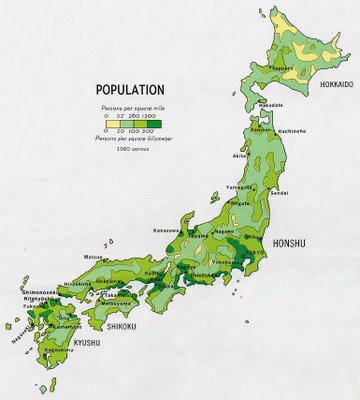 四国 - Shikoku
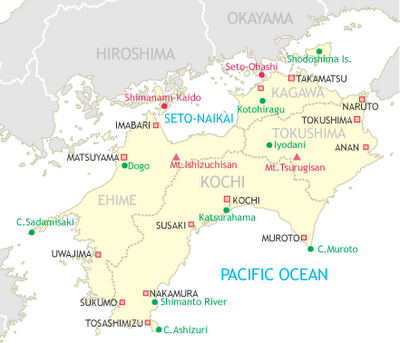 香川県 - Kagawa
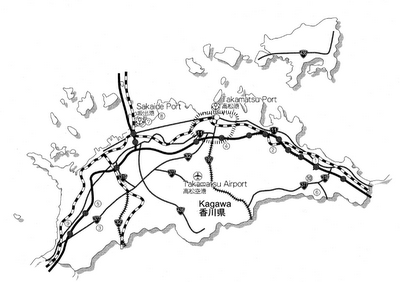 高松市 - Takamatsu
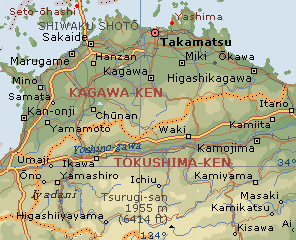
Photos from www.lib.utexas.edu/maps/japan.html, www.nikkanren.or.jp/english/shikoku.html, www.shikoku.meti.go.jp/.../industrial.html, www.bonsai-wbff.org/shimpaku/shim2.shtml, respectively.
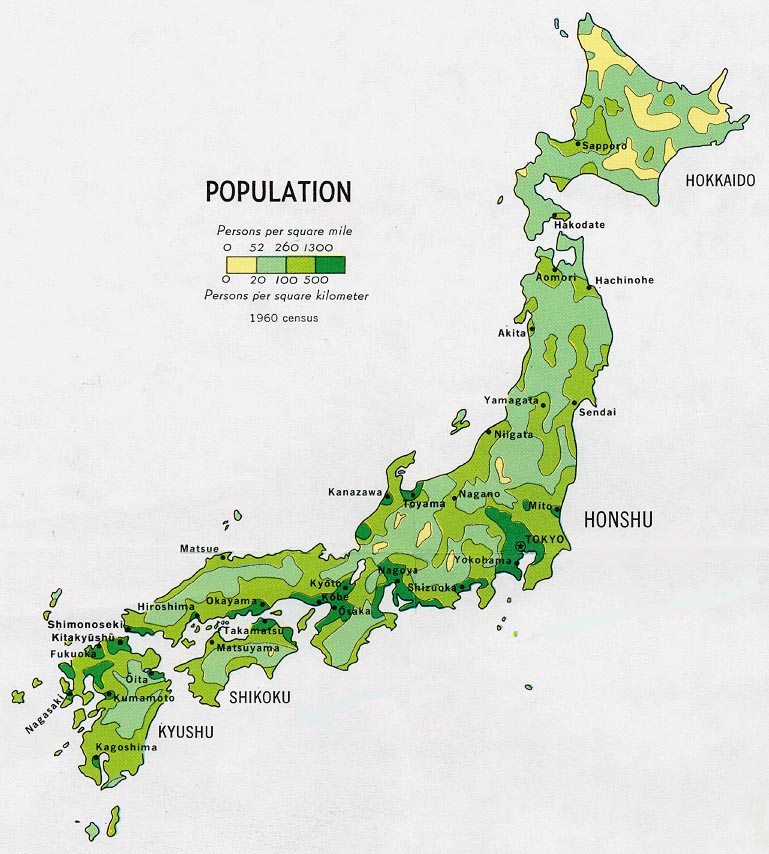 四国 - Shikoku
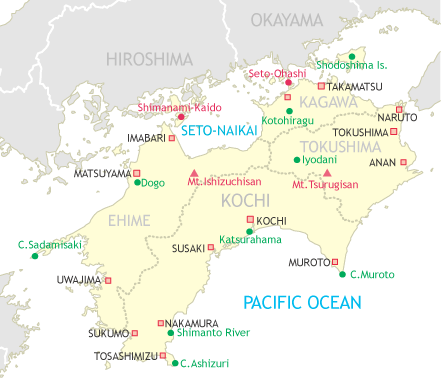 香川県 - Kagawa
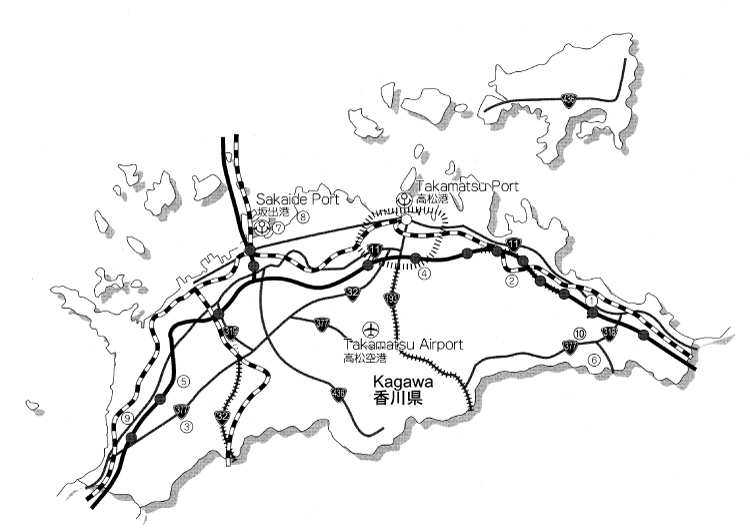 高松市 - Takamatsu
Saturday, August 19, 2006
日本、四国、香川県、高松市
I have begun this blog with the purpose of sharing my travels and experiences of Japanese living as a foreigner to this place. It will include events and stories of what has happened since my arrival here in Tokyo as a participant of the JET (Japan English Teaching) Programme. Through this program, I am based in one of Japan's most memorable cities and will assistant teach junior high school level English for at least one year. I look forward to sharing my experiences, including some i've already had.
このブローグは私は外国人として旅行したり日本の生活をしたりのを公衆に伝えの目的である。JETプログラムの参加で日本に働きにきた時からイベントや話したいなことなどここに書いて入られる目的である。JETプログラムには一年間以上日本に有名なある市に置かれ、中学校で英語指導助手として教えさせてもらうことになっている。この経験についてものを伝えることに楽しみにし、よろしくお願い。
このブローグは私は外国人として旅行したり日本の生活をしたりのを公衆に伝えの目的である。JETプログラムの参加で日本に働きにきた時からイベントや話したいなことなどここに書いて入られる目的である。JETプログラムには一年間以上日本に有名なある市に置かれ、中学校で英語指導助手として教えさせてもらうことになっている。この経験についてものを伝えることに楽しみにし、よろしくお願い。
Subscribe to:
Posts (Atom)